Building a Playwright Test Framework with AI
When I started my assignment at Action in 2024, I had a blank canvas. No existing framework, no automation scripts, nothing. Just a codebase that needed quality assurance and a growing curiosity about AI-powered testing.
What followed was one of the most eye-opening experiences in my 17+ year QA career.
Starting from scratch
I began with a basic Playwright setup. Nothing fancy – just the foundation. A clean project structure, TypeScript configuration, and a clear folder structure to keep projects separated and maintainable.
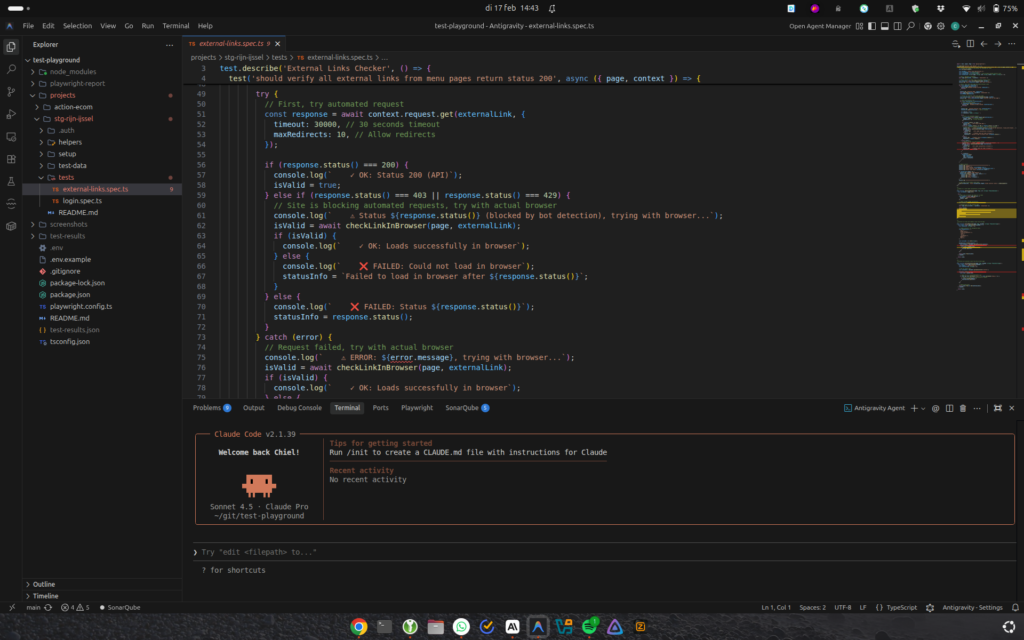
From the start, I made a conscious choice to integrate AI into my workflow wherever possible. Not as an experiment, but as a serious working method. My tools of choice: OpenCode and Claude Pro – and more recently Claude Code, which integrates seamlessly with my existing Claude Pro subscription and gives me a powerful agentic coding assistant directly in my terminal.
AI as my co-pilot
The real shift happened when I started using OpenCode to generate test scripts directly from user stories.
The workflow became:
- Take a user story
- Feed it to OpenCode/Claude
- Review and validate the generated test code
- Test it, iterate where needed
- Ship it
What surprised me most was the quality of the generated code. It wasn’t just syntactically correct – it was well-structured, readable, and often caught edge cases I hadn’t explicitly defined. Even more impressive: AI’s ability to detect errors in its own output and automatically correct them.
One thing I learned quickly: I need to stay in the lead!
AI generates great code, but you still need to verify that it does exactly what you want. The human judgment, the domain knowledge, the QA expertise – that remains essential. AI amplifies it, it doesn’t replace it.
Structure that scales
As the framework grew, I refined the structure:
- Separate folders per project – keeping everything clean and maintainable
- Tests separated by category – each in their own file
- User story ID in every test title – full traceability from requirement to test
Simple decisions, but they made the framework intuitive for anyone joining the project.
The impact: 10x faster!
Here’s the honest truth: AI made me approximately 10 times faster at writing test scripts.
Before AI, creating automated test scripts was time-consuming enough that manual testing was often the quicker option – at least for user story-level tests. That’s a problem, because it means automation never reaches its full potential.
With AI, that barrier disappeared.
Scripts that used to take hours were done in minutes. And because I could create them so quickly, I could actually use them – running automated regression checks after every change, catching issues early, and freeing up time for what matters most: exploratory testing.
That’s where human expertise truly shines. Finding the unexpected. Testing the edge cases. Challenging assumptions. AI gave me the time to do much more of that.
What I would do differently
Honestly? Not much. Except start with AI even earlier.
The combination of a solid Playwright framework and AI-powered test generation is not a future concept. It’s a working reality – and it’s available now.
The bottom line
If you’re a QA engineer still on the fence about AI: stop hesitating.
AI will not make you obsolete. It will make you enormously more effective. The engineers who embrace this now are the ones who will define what quality assurance looks like in the next decade.
Use AI for everything. Stay in the lead. Deliver better quality, faster.